Event Build Planning: 5 Decisions You Should Make Early
There is a point in almost every event project when someone says: “We can sort that nearer the time.”
Sometimes they absolutely can. But after more than 20 years working on temporary event structures, we have also seen how small decisions can become much bigger ones when they are left too late.
Here we’ll run you through what we notice most, and how to tackle any issues ahead of crunch time.
Why do the little details matter?
A structure changes size. A venue confirms that stakes cannot go into the ground. A purchase order takes longer than expected. Access hours change. Additional infrastructure or decor is needed. The CAD drawing needs another revision.
None of these things is particularly unusual in events. The challenge is that every decision is connected to something else.
A ‘small’ change to the structure might affect engineering, ballast, transport and labour. A change to access might affect the vehicle or plant required. A delayed approval could hold up bespoke manufacturing or a third-party booking.
Good planning is not about refusing to change the plan. It is about creating enough room for the plan to change. And planning windows can already be tight.
The Business of Events’ tracker, drawing on data from 350 UK venues, found that booking lead times averaged 87.26 days—just over 12 weeks.
Within that window, a temporary structure project may also need to accommodate site information, drawings, engineering, approvals, plant, transport and installation logistics. The question for organisers, therefore, is not “Can everything be finalised now?” It is “What needs confirming now so the rest of the project still has options later?”
5 Things to Get Right Well Before Build Day
1. Get the commercial confirmation moving early
A quote, an intention to proceed and a confirmed order are not necessarily the same thing.
Depending on the project and supplier terms, stock, bespoke items or third-party equipment may not be committed until the required confirmation, (i.e. purchase order or payment) has been received.
That matters particularly when a build involves items outside a supplier’s standard stock that they have to pay for upfront. Think:
- bespoke walling
- additional ballast
- specialist transport
- hired plant (the list could go on!)
If confirmation is delayed, the solution that was originally propose may still be possible, but it may not, and this is where problems arise. Why? Because the easiest route to delivering it may no longer be available.
Alternative stock might need sourcing, another vehicle could be required or delivery arrangements may have to change.
This is not unique to events. Suppliers need enough time to develop and price the right solutions and compressed or changing procurement timescales can create rushed solutions and additional costs. The UK Government’s ‘Sourcing Playbook’ contains some good advice on this process when it comes to public sector supply, but it’s as important for events that are private sector too.
Top Tips:
- Find out early what actually constitutes a confirmed booking and what depends on it.
- If there’s paperwork that needs to happen to make an order ‘confirmed’ don’t leave this to chance or it’ll reduce your options and cause potential problems down the line.
2. Expect the brief to change—but understand what that change touches
Events evolve. That is part of the job (and one part we secretly – maybe not so secretly?! – love managing!)
Guest numbers change. Branding develops. An additional entrance is requested. A hospitality area grows. Someone decides the structure needs extra flooring or another run of branded walling.
The answer should not automatically be “no, it is too late”. A credible supplier should be able to explain what the change affects first and any impact. Think:
- Does it require a new drawing?
- Does the engineering need revisiting?
- Is more ballast required?
- Does it change the vehicle load, installation time or number of crew needed?
- Is the additional structure (or elements thereof) already in stock, or does it need making or cross-hiring?
- Do these changes affect any health and safety elements? And what paperwork needs to be updated to make sure everything remains compliant?
A change made months before an event and the same change made once vehicles have been loaded are two very different requests with two very different outcomes.
Top Tips:
- When making an amendment, ask your event structure supplier, “What else does this change affect?”
- It is a simple question that can uncover the real implications before a decision is made.
- And importantly, asking it will protect your timelines, budget and outcome.
3. Get the facts before the solution becomes fixed
One of the most valuable pieces of information on any temporary structure build project is often not about the structure at all. It is about the site.
Can vehicles reach the build area? What are the working hours? Are inductions required? What are the ground conditions? Are there underground services? Can the structure be staked? Where will other contractors be working?
HSE’s event guidance says site design should begin with information gathering and an assessment of site suitability, including access and infrastructure. It also stresses the importance of sharing safety information such as the location of buried services.
For example, discovering that a venue will not permit staking late in the day does not simply swap pegs for “a few weights”. Moving to a ballasted solution can affect engineering, the quantity of weight required, delivery, lifting equipment, vehicle movements and potentially the ground beneath that equipment.
Underground services are crucial too. Striking buried electrical cables can result in severe or fatal injuries and safe working should combine planning, service information, locating devices and safe digging practices. If you’re an organiser, it is your responsibility to cover off these areas so you’re not compromising safety or opening yourself up to risk here.
Top Tips:
- Service plans, staking permissions, access restrictions and ground information should sit near the top of the planning discussion list ideally before you confirm your structure.
- Don’t leave this to an email a week before installation!
4. Always treat plant, transport and crew as part of the build
A temporary structure does not arrive on site by itself. (It would be great if it did!)
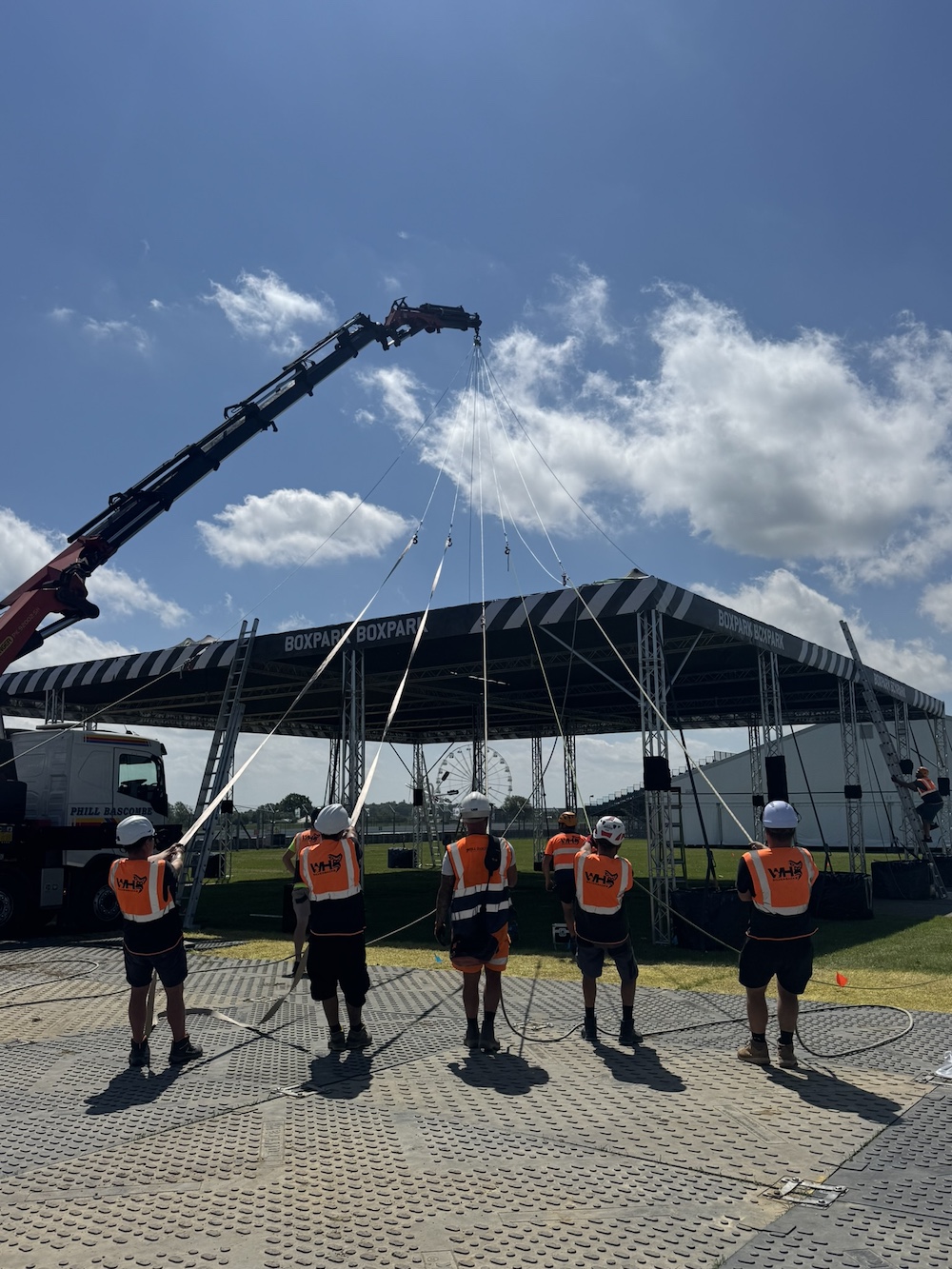
Depending on the job, there may be delivery vehicles, loader cranes or HIABs, telehandlers, forklifts, ballast movements and specialist installation crews involved.
They all need to work within central build programme.
A shorter or amended build window can therefore have consequences beyond simply asking a team to “work a bit faster”. More labour may be needed. Deliveries may need resequencing. Different plant could be required. Collection also needs planning—particularly where a site must be cleared within a strict de-rig window.
The same applies where several contractors share a site. HSE requires coordination between parties involved in event construction. Elements like ‘shared interfaces’ i.e. traffic routes apply here.
Top Tips:
- When dates are shared with suppliers, include the actual access, build and de-rig windows, not just the event dates.
- The devil really is in the detail. Get on top of this in good time and the build will be much smoother. You’ll also be able to identify where you have areas to flex, should you need to.
- The good news? An experienced supplier (like WH Silverbacks) will be able to help map this out for you.
5. Give drawings a point at which they become buildable
CAD is brilliant for working through an event before anyone reaches the site. But it also makes changing something look deceptively easy, which isn’t always the case.
Moving a structure on a drawing might take seconds. In reality, that move could alter access, ground fixing, service locations, interfaces with neighbouring infrastructure or engineering requirements.
This does not mean drawings should never change. It means projects benefit from an agreed design freeze: a point at which the core layout is sufficiently confirmed for engineering, procurement and logistics to move forward.
Changes can still happen after that point, but everyone understands they may carry consequences.
Strong pre-construction information includes details on all critical build elements of the project. Site and hazard information should be developed as part of the design progresses, so designers and contractors can plan the work safely.
Top Tips:
- Always agree who signs off the final drawing, by when, and how later revisions will be communicated.
- Version control is not glamorous, but neither is building from yesterday’s plan.
- Make sure that when you go onsite, the overall plan has been signed off and everyone’s working from the right version.
The real value of planning early
There is a misconception that suppliers encourage early decisions simply because they want an order confirmed. There is actually a much better reason. Time creates options.
With time, a structure can be reconsidered. A site can be surveyed. An alternative fixing method can be engineered. Bespoke elements can be made. Transport can be planned sensibly. Other contractors can be coordinated.
As time reduces, the number of workable options can reduce with it.
There are also the safety elements that are made more robust with appropriate planning time. Clients influence how much time, money and resource is available for construction work, and those decisions can directly affect the health, safety and welfare of the people delivering it.
So the aim is not to have every answer months in advance. It is to know which questions cannot afford to wait.
A good temporary event structure supplier should help identify those questions, explain the knock-on effects of decisions and flag potential issues while there is still time to do something useful about them.
Because great event delivery rarely comes from nothing changing. It comes from planning well enough to deal with change when it does.
Key Takeaways:
- Confirm the site early
- Define what success means
- Lock in build timings
- Compare quotes like-for-like
- Choose experience, not just price.
Planning a Temporary Event Structure?
WH Silverbacks works with event organisers across the UK to design and deliver temporary structures for sporting events, hospitality, festivals and live experiences, backed by more than 20 years’ industry experience.
If your next brief is still taking shape, that is a good time to talk. Share the site, dates and what is known so far, and we can help identify what needs confirming early, flag potential challenges and quote for a solution that is safe, practical and right for the event.
Contact one of our experts today:
T: 01202 096957